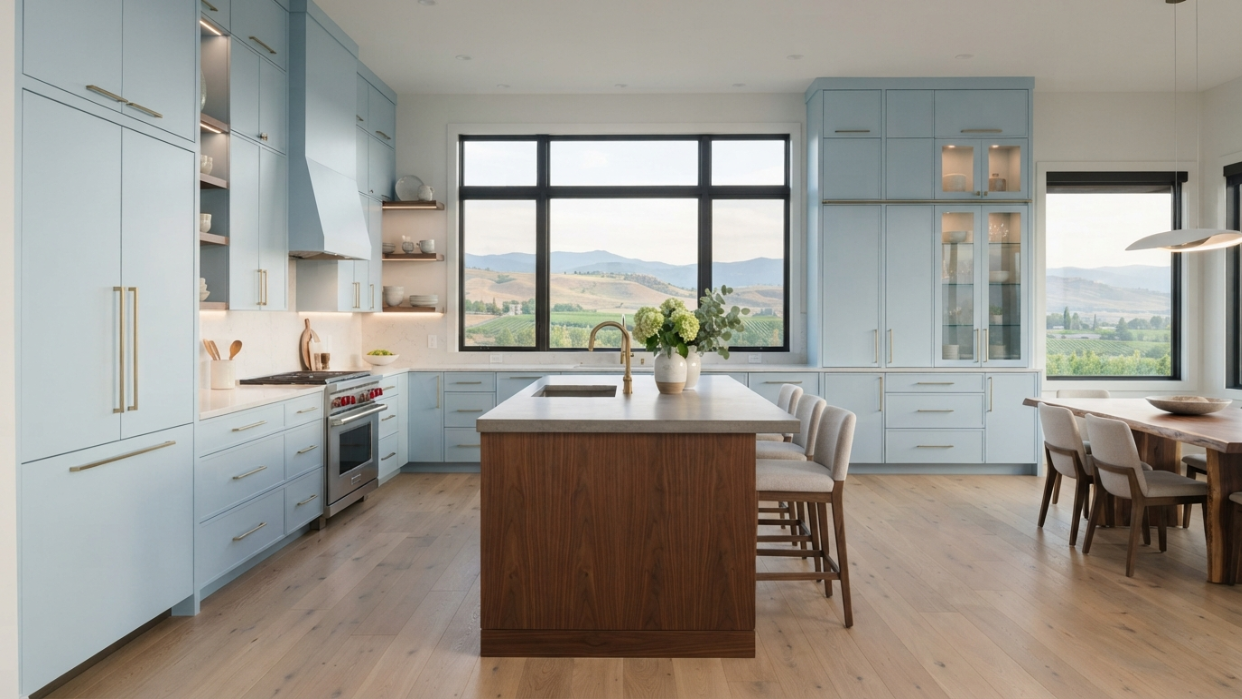
Home storage systems require a balance between spatial efficiency and material durability. Standard retail shelving often falls short in rooms with non-standard dimensions or specific architectural footprints. Homeowners frequently discover that mass-produced units leave empty gaps, reduce usable square footage, and fail to hold up under heavy daily use. Transitioning to custom cabinets Yakima WA allows property owners to configure storage layouts that fit exact wall-to-wall measurements while choosing specific lumber species and hardware mechanisms.
The Pacific Northwest climate introduces seasonal humidity shifts that impact interior woodwork. Yakima experiences hot, dry summers and cold, snowy winters, causing indoor relative humidity levels to fluctuate. Solid wood and engineered substrates react differently to these shifts. Selecting the correct materials and joinery styles determines whether a cabinet door remains square or warps over time. Professional design involves evaluating species density, moisture resistance, and face-frame engineering to ensure longevity.
Material Selection and Regional Climate Resilience
Wood is a hygroscopic material, meaning it constantly absorbs and releases moisture to match its surrounding environment. In Central Washington, where the climate moves between semi-arid summers and damp winters, timber stability matters. Cabinet components expand across the grain when humidity rises and contract when the air dries out. If a cabinet box is poorly constructed, this movement forces joints apart and misaligns doors.
| Material Type | Dimensional Stability | Best Structural Use | Moisture Resistance |
|---|---|---|---|
| Hard Maple | Moderate to High | Door frames, face frames, heavy-use drawers | Moderate (requires sealed coating) |
| Rift-Sawn White Oak | High | External cladding, kitchen islands, vanities | High (natural tyloses block water) |
| Marine-Grade Plywood | Very High | Cabinet boxes, sink bases, utility rooms | Excellent (waterproof adhesives) |
| High-Density Fiberboard (HDF) | Excellent (No grain) | Painted slab doors, decorative panels | Low (unless specifically moisture-rated) |
Plywood core construction offers superior stability compared to particleboard for the cabinet box itself. High-grade Baltic birch plywood contains multiple cross-banded layers held together by exterior-grade resins. This cross-lamination restricts the wood from expanding or contracting in any single direction. Hard maple remains a preferred choice for face frames due to its high impact resistance and smooth grain pattern that takes paint without telegraphing texture beneath the finish.
White oak cut using a rift-sawn method provides linear grain lines and exceptional structural stability. The cutting technique exposes the vertical grain, reducing the radial expansion coefficient. This protects the cabinet from warping along the agricultural valleys of Yakima County where irrigation moisture can raise localized indoor humidity during summer months.
Architectural Joinery Techniques and Load-Bearing Capacity
The strength of a cabinet rests on its joints. Mass-market pieces rely heavily on cam locks, plastic brackets, or simple butt joints held together by staples. These methods fail under the weight of heavy stoneware, cast-iron cookware, or small kitchen appliances. Master cabinetmakers rely on mechanical interlocks that distribute weight across the wood fibers.
- Dovetail joints feature interlocking wedge-shaped fingers that provide high tensile strength for drawer boxes.
- Mortise and tenon construction inserts a carved projecting tongue into a matching square hole for rigid face frames.
- Dado joints cut a deep channel across the grain of one board to cradle the edge of a connecting shelf securely.
- Doweled joints utilize pressed hardwood pins glued into precision-bored holes to prevent panel twisting.
Dovetail joints resist pull forces, making them ideal for deep drawers holding heavy pots near cooking ranges. When a drawer is pulled open repeatedly, the mechanical shape of the dovetail prevents the front panel from separating from the sides. This eliminates reliance on glue alone to hold the structure together over decades of use.
Dado joints are critical for interior shelving and vertical partitions. By recessing the shelf into the side panel by one-third of the material thickness, the vertical wall supports the weight directly. This eliminates the risk of shelf collapse that occurs when small plastic shelf pins bend or shear off under load forces.
Framed Versus Frameless Construction Methodologies
The debate between traditional American framed cabinets and European frameless designs centers on aesthetics and accessible space. Framed cabinetry utilizes a solid wood face frame attached to the front of the box. This frame acts as a structural reinforcing element, keeping the box square during installation. Doors attach directly to the frame face, allowing for inset, partial overlay, or full overlay configurations.
Frameless cabinetry relies on thicker side walls, usually three-quarters of an inch thick, to maintain structural integrity without a front frame. This approach maximizes interior storage space and drawer width since there are no face frame lips blocking the opening. European hinges attach directly to the inside walls of the box. The choice impacts how storage space functions in tight residential layouts found in older homes near South 16th Avenue or newer developments out toward Scenic Drive.
Optimizing Kitchen Workflows and Local Valuation Dynamics
Kitchen layouts dictate daily movement efficiency. Cabinet placement should align with the classic work triangle concept defined by the National Kitchen and Bath Association (NKBA). This framework optimizes the distance between the refrigerator, the sink, and the main cooking surface. Custom configurations allow for exact adjustments that prefabricated lines cannot accommodate due to strict size increments.
According to U.S. Census Bureau data, the median household income in Yakima rests around $63,000, making long-term home investments a key factor in wealth preservation. Upgrading fixed assets with high-grade cabinetry improves property liquidity and market appeal. Homes located near Nob Hill Boulevard or the historic areas of the city retain value better when renovations focus on durable materials rather than temporary cosmetic fixes.
Integrating specialized pull-out systems directly into the cabinetry framework prevents countertop clutter. Deep base cabinets can feature blind corner pull-outs with articulated tracks that bring items from the back of the cabinet into full view. Vertical tray dividers keep baking sheets organized, while built-in recycling centers hide waste bins behind matching door panels.
Vanity Engineering for High-Moisture Bathrooms
Bathroom environments present severe challenges to woodwork due to localized steam and direct water exposure near plumbing fixtures. Vanity bases require materials that resist delamination. Marine-grade adhesives and solid lumber components prevent the swelling that destroys standard medium-density fiberboard (MDF) bases when exposed to standing water on floors.
Suspended or floating vanities require heavy-duty internal blocking to transfer the cantilevered load safely to the wall studs. This installation method opens up floor space, making smaller bathrooms feel larger while simplifying floor cleaning. The mounting framework must use heavy lag bolts anchored into structural framing timber, especially when supporting heavy quartz or granite countertops.
Functional Integration of Smart Storage Systems
Modern cabinetry integrates mechanical assists to improve accessibility. Soft-close hinges and drawer slides utilize fluid dampers to slow the closing action before the door or drawer strikes the frame. This dampening mechanism protects the joinery from impact stress and reduces ambient noise inside the home.
Touch-to-open latches permit clean, hardware-free cabinet fronts, opening with a light tap from a knee or elbow when hands are full during meal preparation. Lift-up door mechanisms replace traditional side-swing hinges on upper cabinets, moving the door vertically out of the user’s field of movement. This system is useful in tight galley kitchens or high-traffic corridors where open doors obstruct pathways.
Frequently Asked Questions
What is the typical lifespan of custom wood cabinets compared to stock options?
Custom cabinets built with solid face frames and premium plywood boxes last between 30 and 50 years when properly maintained. Stock cabinets made from low-density particleboard and vinyl wraps often show signs of edge peeling, sagging shelves, and hinge failure within 5 to 10 years of installation.
How does local climate affect the choice of cabinet finishes?
The dry summers and cold winters of Central Washington require a finish that retains flexibility. Conversion varnishes and post-catalyzed lacquers create a chemical bond that flexes alongside the natural movement of the wood grain, preventing the finish from cracking along the joint lines.
Can existing cabinet boxes be reused if only the style needs an update?
If the original structural boxes are constructed of high-quality plywood and remain square, level, and free of water damage, cabinet refacing is possible. This process replaces only the doors, drawer fronts, and exterior skin panels, saving material costs while altering the room style.
Why is plywood preferred over solid wood for the internal cabinet boxes?
Solid wood panels expand and contract significantly across their width, which would cause cabinet boxes to buckle and twist. Plywood solves this issue through alternating grain layers that lock each other in place, providing a flat, stable surface for shelves and drawer tracks.
Final Thoughts
Investing in custom cabinetry ensures that home storage systems are engineered specifically for the spatial challenges and environmental conditions of the property. Selecting stable regional hardwoods, utilizing interlocking joinery, and planning functional layouts creates durable installations that enhance daily home utility.